
May 22, 2026
How to Turn Your Wedding Bells into a Citizenship Certificate
How to Turn Your Wedding Bells into a Citizenship Certificate
What You Need to Know About Citizenship Through Marriage Texas
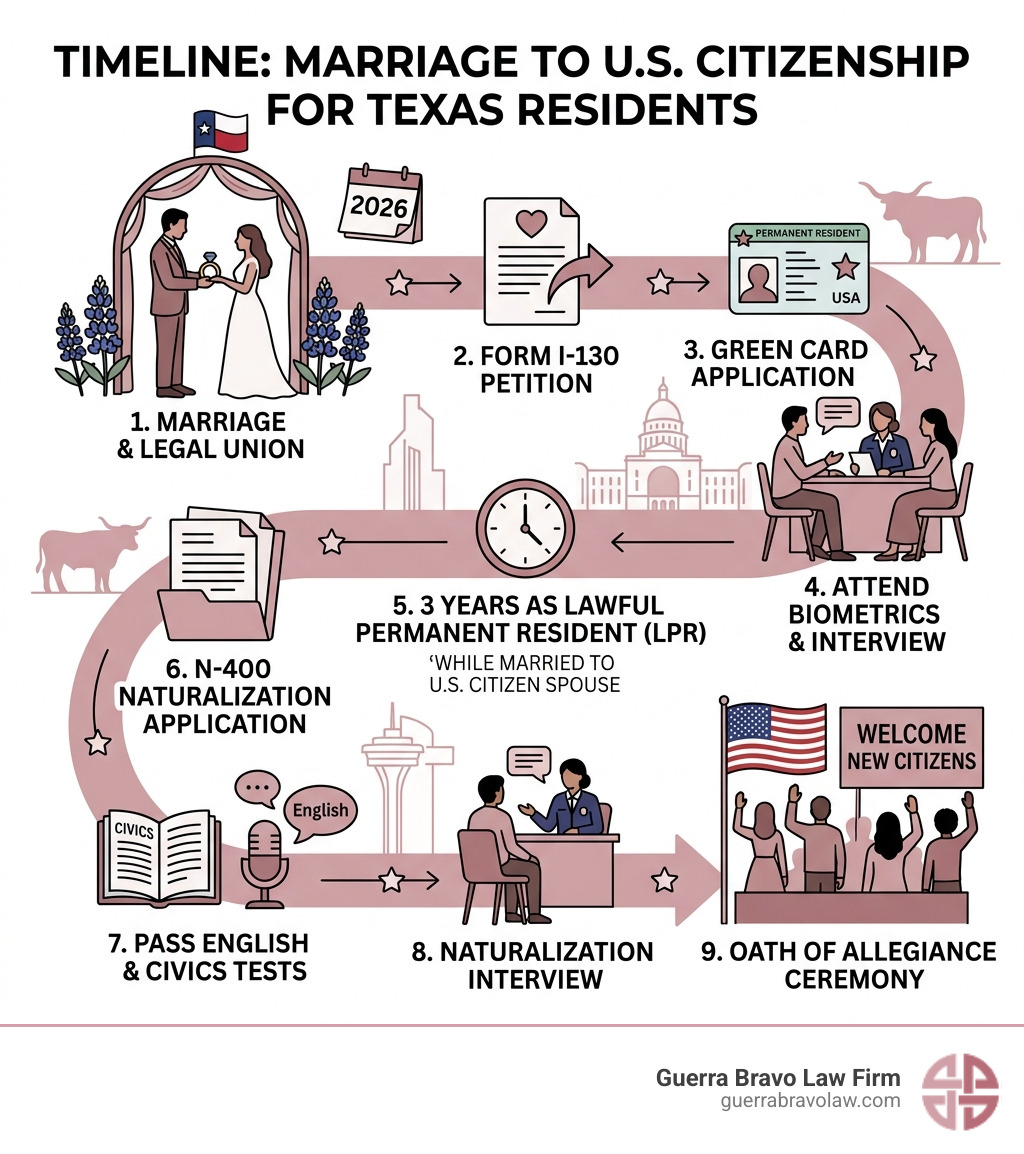
Citizenship through marriage Texas is a two-stage legal journey: first you secure a Green Card as a lawful permanent resident (LPR), then — after 3 years of marriage and residency — you apply for full U.S. naturalization.
Here is a quick overview of the path:
Stage 1 — Get Your Green Card
-
U.S. citizen spouse files Form I-130 to establish the relationship
-
Foreign spouse applies for Adjustment of Status (if in the U.S.) or Consular Processing (if abroad)
-
Attend biometrics and a USCIS interview
-
Receive a conditional (2-year) or permanent (10-year) Green Card
Stage 2 — Apply for Citizenship
-
Live as a lawful permanent resident for 3 continuous years while married to your U.S. citizen spouse
-
Meet physical presence requirements (at least 18 months inside the U.S. during those 3 years)
-
Pass the English and civics tests
-
Attend your naturalization interview and Oath of Allegiance ceremony
Marriage to a U.S. citizen is one of the most common — and most direct — paths to permanent residency and citizenship. During just the first three quarters of 2020 alone, nearly 166,000 spouses of U.S. citizens obtained lawful permanent residency in the United States.
But here is what surprises many people: the process is not automatic. A marriage certificate alone is not enough. USCIS requires substantial proof that your marriage is genuine, that you meet specific residency thresholds, and that you are a person of good moral character.
Texas residents face the same federal requirements as everyone else, but local factors — from which USCIS field office handles your case to Texas’s own recognition of common law marriages — can shape your experience in important ways.
This guide walks you through every step, from your first immigration form to the moment you take the Oath of Allegiance.
The Foundation: Securing a Green Card Through Marriage in Texas
Before you can even think about a citizenship certificate, you must first become a Lawful Permanent Resident. In immigration, we often call this “getting your Green Card.” For many of our clients in the Rio Grande Valley, this starts with a Family-Based Petition Complete Guide to understand how the U.S. citizen spouse sponsors the foreign spouse.
The primary tool for this is Form I-130, the Petition for Alien Relative. This form tells the government, “Hey, we are legally married, and I want my spouse to live here permanently.”
Depending on where the foreign spouse is currently living, the path splits into two directions:
Adjustment of Status • Who it is for: Spouses already inside the U.S. who entered legally (even if they overstayed a visa). • The Benefit: You can often stay in the U.S. while the application is pending and apply for work authorization. • The Process: You file Form I-485 concurrently with the I-130. This is known as Ajuste de Estatus.
Consular Processing • Who it is for: Spouses currently living outside the United States. • The Process: After the I-130 is approved, the case moves to the National Visa Center (NVC) and eventually to a U.S. Embassy or Consulate in the spouse’s home country for an interview.
Understanding the Form I-130 Timeline is crucial, as it can take several months to over a year depending on USCIS backlogs. For those in our local communities like McAllen or Edinburg, knowing How to Get Green Card Texas Immediate Family status means you aren’t stuck waiting behind “preference categories”—you are at the front of the line because spouses of U.S. citizens are considered “immediate relatives.”
Eligibility Requirements for Citizenship Through Marriage Texas
To successfully navigate the citizenship through marriage Texas process, you must meet strict federal eligibility criteria. USCIS isn’t just looking for a marriage certificate; they are looking for a partnership built on more than just a desire for a passport.
Core Eligibility Criteria • Legal Validity: Your marriage must be legally recognized in the place where it was performed. • Bona Fide Intent: You must prove the marriage is “bona fide,” meaning it was entered into for love and a shared life, not solely for immigration benefits. • Age: The applicant must be at least 18 years old. • LPR Status: You must already hold a Green Card (be a Lawful Permanent Resident).
According to the U.S. Citizenship Through Marriage – USCIS Guide, one of the biggest advantages for spouses is the “3-year rule.” While most Green Card holders have to wait 5 years to apply for citizenship, spouses of U.S. citizens can often apply in just 3 years.
If you find yourself asking Top Immigration Marriage Questions, your spouse must have been a U.S. citizen for the entire 3-year period you are relying on for eligibility.
Proving a Genuine Relationship to USCIS
This is where the “paperwork” gets personal. USCIS officers are trained to spot “sham marriages.” To win them over, we help our clients gather a mountain of evidence that shows two lives intertwined.
You will need to submit Form I-130A Complete Guide along with the initial petition, which provides supplemental information about the spouse. But the real proof lies in your daily life.
Commonly Accepted Evidence • Joint Financial Assets: Joint bank account statements, credit card statements, and shared tax returns. • Shared Housing: A lease agreement with both names, a mortgage statement, or property deeds. • Insurance and Benefits: Health, life, or auto insurance policies naming each other as beneficiaries. • Family Ties: Birth certificates of children born to the relationship. • The “Fun” Stuff: Photos of the wedding, vacations, and family gatherings, along with travel records like flight itineraries. • Affidavits: Sworn statements from friends or family members who can attest to the relationship.
Providing this evidence upfront can help you avoid a “Request for Evidence” (RFE), which can stall your case for months. For those worried about what happens if things go wrong, it is wise to understand Qué Pasa Si Me Niegan la Residencia por Matrimonio (What happens if residency is denied).